Rechercher dans ce blog

Monday, February 1, 2021

Sony's Dr. Hiroaki Kitano Named Fellow by the Association for the Advancement of Artificial Intelligence - PRNewswire

sony.indah.link

TOKYO, Feb. 1, 2021 /PRNewswire/ -- Dr. Hiroaki Kitano, Executive Vice President, Officer in charge of AI Collaboration at Sony Corporation, President and CEO of Sony Computer Science Laboratories, Inc. and CEO of Sony AI Inc. has been named a fellow of the Association for the Advancement of Artificial Intelligence.  In addition to his key roles in AI at Sony, Dr. Kitano is also the Founding Trustee of the RoboCup Federation, an international scientific initiative that was created to best promote research in the area of intelligent robotics and artificial intelligence, as well as related fields.

Dr. Kitano's recognition comes from "demonstrating great contribution and leadership in robotics, massively parallel AI, scientific discoveries by AI, and the use of AI in systems biology."

"Sony seeks  to create new value through technology and as such, we have high expectations for AI, which can positively impact Sony's existing businesses in electronics, image sensors and entertainment, and in creating new businesses," said Kenichiro Yoshida, Chairman, President and CEO, Sony Corporation. "In addition, we believe AI has the potential to contribute to society in business domains that Sony pursues from a long-term perspective, such as health, personal finance, and in the evolution of next-generation mobility. Through groundbreaking research in AI, Dr. Kitano has greatly contributed to technological development at Sony. We are extremely happy and proud for him to be selected fellow of such a prestigious society."

"From my early days a researcher to today, I have always believed that artificial intelligence would make significant improvement in peoples' lives," said Dr. Kitano.  "In particular, I have been engaged in research that integrates AI, massively parallel computing, robotics, and systems biology. In addition, RoboCup was founded as a mechanism to accelerate research and development of AI and robotics. To promote the tight integration of the aforementioned four research fields centered on AI, I am now in the process of launching a new Grant Challenge Project to drive scientific discovery through AI. I believe the fusion of these fields with AI playing a key role will pick up even more speed and play a central role in addressing global issues, pioneering new frontiers and shaping societies and industries. As the role that AI plays is extremely large, I want to thank the AAAI for its dedication to promote AI research and for this tremendous honor."

Dr. Hiroaki Kitano began his career as a researcher on software engineering at NEC corporation before moving to Carnegie Mellon University to start his AI research. In 1993 he joined Sony Computer Science Laboratories, Inc. (CSL) as a Researcher.  In 2008 he was promoted to Director of Research at CSL and since 2011 he serves as President and CEO of CSL.  He also serves as Director of Sony Global Education, and, in June 2020, was named Executive Vice President and Officer in Charge of AI Collaboration for Sony Corporation and CEO of Sony AI in April 2020. Kitano is a recipient of The Computers and Thought Award in 1993, Nature Award for Creative Mentoring in Science (Mid-carrier award) 2009, served as a president of International Joint Conferences on Artificial Intelligence (2009-2011), a member of scientific advisory board for numerous academic institutions including European Molecular Biology Laboratory (EMBL), currently serving as a professor at Okinawa Institute of Science and Technology Graduate School.

About AAAI

The Association for the Advancement of Artificial Intelligence (AAAI) is a nonprofit scientific society devoted to advancing the scientific understanding of the mechanisms underlying thought and intelligent behavior and their embodiment in machines. AAAI's Fellows Program recognizes individuals who have made significant, sustained contributions to the field of artificial intelligence. 

About Sony AI

Sony AI Inc. was founded on April 1, 2020, with the mission to "unleash human imagination and creativity with AI." Sony AI combines Sony Group's imaging and sensing technology, robotics technology, and entertainment assets such as movies, music, and games to transform with cutting edge artificial intelligence R&D to accelerate all of Sony's business areas and create new business opportunities. To achieve this, Sony AI has launched three flagship projects aimed at the evolution and application of AI technology in the areas of "Gaming," "Imaging & Sensing," and "Gastronomy." Sony AI will promote various exploratory research related to these flagship projects and other important themes, including AI ethics, in the physical and virtual worlds. For more information visit https://ai.sony.

SOURCE Sony

Related Links

http://www.sony.com

The Link Lonk


February 02, 2021 at 08:00AM
https://ift.tt/36vY8be

Sony's Dr. Hiroaki Kitano Named Fellow by the Association for the Advancement of Artificial Intelligence - PRNewswire

https://ift.tt/2ZeUDD8
Sony

Sony A1 first verdict: Canon's AF is better, "30fps failure", standard 8K lasts 16 mins - Digital Camera World

sony.indah.link

The first verdict of the Sony A1 is in – and the big takeaways are that the autofocus isn't as good as Canon's, and the camera doesn't always live up to its promises of 30fps burst shooting and 30 minutes of 8K video. 

The Sony A1 was announced with plenty of pomp in January, with specs that on paper looked to outclass the mighty Canon EOS R5. However, paper and practice are two different things – and the first hands-on test of the new camera paints a much more grounded picture.

• Read more: Sony A1 vs Canon EOS R5

Popular photography YouTuber Tony Northrup gave his early verdict on the Sony A1 and many of its features compared to the R5. And while he came away largely impressed, it was notable that the body fell short of expectations in a number of key areas.

First and foremost, the autofocus is not as good as that found in the R5 and Canon EOS R6. While Northrup noted that the real-time tracking is better than any other camera made by Sony – including the Sony A9 II sports camera and 61MP Sony A7R IV – "it will inevitably wander onto the foreground or background, even with a completely still subject". 

In particular, the human eye AF is still more like "eyelash AF", animal eye AF still suffers from front-focusing issues, and the highly touted bird eye AF is "not great" and very inconsistent. "Some birds, it never finds the eye; other birds it seems to find it all the time… but it's not reliable enough to use." This is compounded by overactive hunting, when shooting at 600mm, pulling focus in the wrong direction about half the time.

Regarding the headline 30fps burst shooting feature, Northrup's tests revealed that the Sony A1 could hit that target – provided that the subject was perfectly still. However, when shooting birds at 600mm, the best Northrup could achieve was 19fps – which is actually below the consistent 20fps advertised and achieved by the Canon EOS R5. 

Moreover, if using a non-Sony lens (such as a Sigma or Tamron optic) the A1 is "hard-coded to drop down to lower frame-rates – specifically, the best it's going to do is 15 frames per second". 

When it comes to 8K video overheating, in 'standard' mode the Sony A1 shut down after 16 minutes – far short of the claimed 30 minutes shooting time. However, in 'high' mode it could record for about 80 minutes in total. Clearly that's an enormous difference, in terms of how the camera behaves out of the box and how it handles overheating in the adjusted mode. We're very intrigued to learn what measures or compromises are involved with the higher heat tolerance… 

The full video covers plenty of other A1 features, such as the brilliant EVF, improved flash sync speed and near-elimination of rolling shutter. We look forward to bringing you our own verdict of the Sony A1 when we publish our full review soon. 

Read more: 

Sony A1 vs Sony A9 II vs Sony A7R IV
Best Sony camera
Canon EOS R5 review

The Link Lonk


February 01, 2021 at 06:39PM
https://ift.tt/3j8AWoB

Sony A1 first verdict: Canon's AF is better, "30fps failure", standard 8K lasts 16 mins - Digital Camera World

https://ift.tt/2ZeUDD8
Sony

Sony Music buys AWAL and Kobalt Neighbouring Rights from Kobalt Music Group - Music Business Worldwide

sony.indah.link

Well, this shakes up February.

Sony Music Entertainment (SME) has entered into a definitive agreement to acquire two companies from Kobalt Music Group, MBW can reveal.

UPDATE: Sony Corporation has now confirmed that the deal is costing Sony Music USD $430 million.

One of those companies is AWAL, the recorded music services firm that works with independent artists including Lauv, Finneas, AG Club, girl in red, Nick Cave & The Bad Seeds, and Little Simz.

The other is performance rights collection agency Kobalt Neighbouring Rights (KNR), which has distributed more than $250 million to over 2,000 artist and label clients since 2013, including the likes of Cardi B, Ed Sheeran, Ariana Grande, Concord, Secretly Canadian and others.

So long as the acquisitions clear the usual regulatory conditions, both AWAL and KNR will become owned by Sony Music.

The two ex-Kobalt companies will jointly form a new division at Sony Music, which the major says will be “enhanced by the technology and network” of SME’s existing independent music distribution/services company, The Orchard.

Lonny Olinick will remain AWAL’s CEO.

AWAL – which has also previously worked with the likes of Lil Peep, Tom Misch, R3hab, and Rex Orange County – offers indie artists services such as distribution, marketing, radio promotion, analytics, and synch.

Under Sony Music, AWAL will operate outside of The Orchard, continuing to sign, develop and market its own artists. However, Sony says that The Orchard will “power” AWAL’s operation, including the fact that “AWAL artists will be able to capitalize on SME’s and The Orchard’s global distribution footprint”.

Sony Music says it intends to invest in AWAL in future “to grow [its] service offerings”.

“Our investment in AWAL’s continued growth gives us another level of service to offer the independent music community.”

Rob Stringer, Sony Music

As part of the agreement, Sony Music-signed artists and The Orchard-distributed labels will be able to partner with the operation formerly known as Kobalt Neighbouring Rights, which continues to be run by Ann Tausis.

Rob Stringer, Chairman, Sony Music Group said: “Our investment in AWAL’s continued growth gives us another level of service to offer the independent music community. With their flexible solutions to building artist careers, together we will offer creators more exciting choices to connect with their audience worldwide.”

Brad Navin, CEO, The Orchard, said: “The Orchard’s comprehensive offerings, global footprint and technology will contribute to AWAL’s continued success. We will give more artists a transparent, global solution and access to multiple touch points to release their music however they choose.”

Lonny Olinick, CEO, AWAL said: “The AWAL team has futuristically enabled artists to deliver their creative vision since its inception. Now, as part of the global Sony ecosystem, we can dramatically expand on this vision for them.

“We are also excited to build on our innovative neighboring rights as well as DIY platforms with extended support from The Orchard.”

“The AWAL team has futuristically enabled artists to deliver their creative vision since its inception. Now, as part of the global Sony ecosystem, we can dramatically expand on this vision for them.”

Lonny Olinick, AWAL

Reports in September last year suggested that Kobalt Music Group (KMG) was sounding out the market regarding a potential sale of its business and/or a capital raise.

Outside of AWAL and Kobalt Neighbouring Rights, two of Kobalt’s flagship divisions will now remain under the ownership of KMG: Kobalt Music Publishing (for music publishing), and AMRA (for global royalty collection).

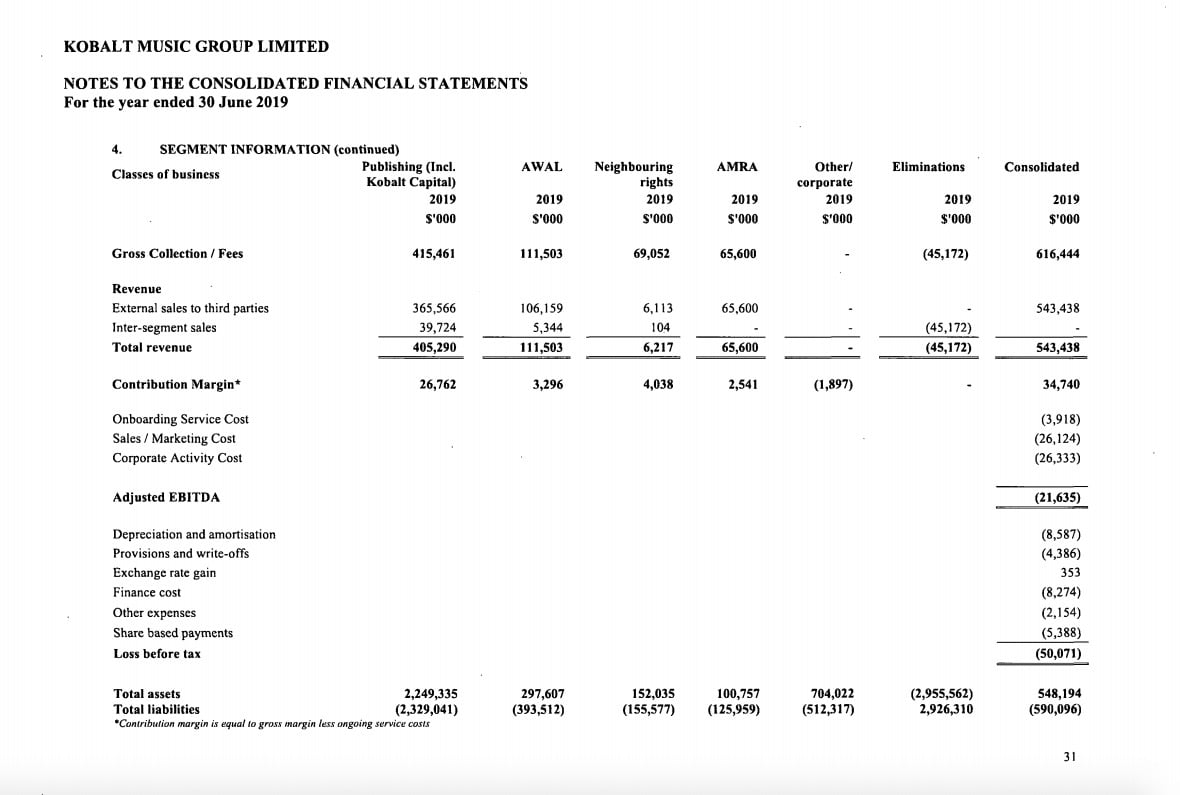
In the 12 months to end of to the end of June 2019, AWAL saw its revenues increase by 86% year-on-year to $111.5 million, according to a filing with UK Companies House. That FY2019 filing also revealed that AWAL posted a $3.3 million annual contribution margin, denoted as “gross margin less ongoing service costs”.

In the same 12 months, Kobalt Neighbouring Rights generated $69.05 million in gross collections, while posting a $4.04 million annual contribution margin.


Sony Music’s acquisition of AWAL from Kobalt continues the major’s strategy of acquisitive growth in the world of independent label and artist services, under Sony Music Group Chairman Rob Stringer.

Last month, Sony Music announced the buyout of J.Erving’s independent artist services company, Human Re-Sources, which has now become part of The Orchard.

In 2017, Sony Music and The Orchard acquired two European distributors – Phonofile and finetunes – which significantly boosted The Orchard’s distribution market share in Europe.

“We strongly believe we can profitably grow The Orchard and expand the artist, label and distribution services that [Sony Music] provides to indie labels and unsigned artists – a growing segment in the digital music sphere.”

Rob Stringer, speaking in 2017

In April 2017, Rob Stringer set out his vision for his leadership of Sony Music, noting that the major’s future investment in The Orchard was a “key piece” of its over-arching strategy.

Said Stringer: “We strongly believe we can profitably grow [The Orchard] and expand the artist, label and distribution services that we provide to indie labels and unsigned artists – a growing segment in the digital music sphere.”

Sony fully acquired the Orchard in March 2015, buying the half of the company it didn’t already own in a $200 million deal.


Kobalt’s AWAL offers three different deal types, depending on the stage of an artist’s career and the level of investment/resource required.

An ‘AWAL Core’ deal is rooted in basic distribution and is thought to charge around 15% of royalties generated by an artist; the next step, AWAL+, layers in more services for around 30%; and finally there’s its most committed strain of deal, via AWAL Recordings, which AWAL calls a “global record label built to break artists on their own terms”.


In June 2018, AWAL acquired New York-based independent radio promotion company In2une.

Founded in 2007 by Dale Connone, in2une handles multi-format radio promotion for independent labels and artists, in addition to other services including playlisting, social & digital strategy, and campus promotion.Music Business Worldwide

The Link Lonk


February 01, 2021 at 07:59PM
https://ift.tt/39zLY34

Sony Music buys AWAL and Kobalt Neighbouring Rights from Kobalt Music Group - Music Business Worldwide

https://ift.tt/2ZeUDD8
Sony

Sony's MLB The Show comes to Xbox for the first time on April 20th - Engadget

sony.indah.link

MLB The Show is stepping up to the plate on Xbox for the first time. This year's edition, MLB The Show 21, will be available on PlayStation 5, PlayStation 4, Xbox One and Xbox Series X/S on April 20th. Better yet, the game will have cross-play and cross-progression support, so Xbox and PlayStation players can face off against each other on the field. 

It emerged in late 2019 that the franchise would expand to non-PlayStation consoles as early as this year. San Diego Studio will show off MLB The Show 21's new features in a series of Feature Premiere videos, the first of which will be released in March. 

On the downside, the standard edition of MLB The Show 21 will be more expensive on PlayStation 5 and Xbox Series X/S than PS4 and Xbox One. There's no free upgrade path for the standard edition, which costs $60 on PS4 and Xbox One, and $70 on PS5 and Xbox Series X/S.

The collector's edition will allow you to play across both console generations, which may be useful if you have a PS5 in your living room and a PS4 in your bedroom. Details about the collector's edition will be revealed on Wednesday. 

This will be the first time that PlayStation Studios has published one of its games on a competitor's consoles. The company brought Horizon Zero Dawn to PC last year and has said it might do the same with other first-party PlayStation games. 

The Link Lonk


February 01, 2021 at 11:32PM
https://ift.tt/3j4ZXRN

Sony's MLB The Show comes to Xbox for the first time on April 20th - Engadget

https://ift.tt/2ZeUDD8
Sony

How Sony Forged, Then Squandered, Its Relationship With Linux Users - VICE

sony.indah.link

As companies innovate over time, they inevitably take things away. In the case of Apple’s M1 chip, for example, it took away the ability to upgrade basically anything.

As I wrote last year, the Apple Silicon shift is not its first move away from a CPU architecture, but its third, and the parallels between the transitions from PowerPC and Intel are interesting to watch in real time. Now, while it was the most influential company that offered PowerPC computers for sale, it was technically not the largest—not by a long shot.

Advertisement

The winner was technically the Nintendo Wii, which sold more than 100 million units during its seven-year history on the console market, all while rocking a variant of the PowerPC G3 processor line used in many early Macs. And it wasn’t alone: The Wii’s primary competitors in home video games at the time—the Xbox 360 and the PlayStation 3—also used architecture based on the PowerPC.

The PlayStation 3, while it did not best the Nintendo Wii, may have bested Apple at making the most popular PowerPC platform intended for a degree of general purpose computing … well, until Sony, under duress, threw that crown away.

Let’s talk about the complicated nature of Linux on game consoles—a story that gets particularly complicated when the discussion turns to what Sony did on the PS3.

Why Linux has always found a home on video game consoles

As operating systems go, Linux is a chameleon, one that can be installed on architectures both incredibly mainstream and absurdly obscure.

One architecture in the obscure category is SuperH, a chipset released by Hitachi in the 1990s that was used in three of Sega’s consoles—the 32X, Saturn, and Dreamcast—and not many other places. Where it appeared, however, made a compelling case for a powerful 32-bit chip, one capable of powering Virtua Fighter and Crazy Taxi alike.

Advertisement

Despite the fact that SuperH (also known as SH) hasn’t seen an architectural update since the mid-2000s, its compressed instruction set approach to code directly inspired the evolution of modern ARM processors (to the point where ARM literally licensed the functionality from Hitachi), meaning that it has maintained a degree of relevance in the modern day.

And a number of Linux developers have helped to carry SuperH into the modern age after the chipset’s patents expired about five years ago.

“We didn’t have to write new code; we just had to dig some of it up and dust it off,” said Rob Landley, one of the developers that led the effort to revive SuperH as an open architecture under the “J-core” name.

Chipsets like these would be forgotten about if not for Linux helping to push them forward.

And often, this means that you can find Linux implementations for video game consoles (admittedly, of varying age and quality). The Dreamcast is a good example. With the device sporting a VGA port, a first-party keyboard, and an optional Ethernet adapter, it has a lot of the elements that could make it a good choice for installing some form of Linux. And well, people have. It’s not going to be as updated as an implementation on an x86 platform, or even a Raspberry Pi or Pine64 device. But in many ways the fact that it can be done at all makes it interesting to some.

Advertisement

Among common video game consoles, probably the earliest you’ll find a working Linux variant for is the original PlayStation, which relies on a MIPS architecture. But expect to do a lot of digging on old forums or in the Internet Archive for a copy, as it was released in 2001 and the sites that hosted it are long dead.

There have even been attempts on the Nintendo 64, though they started slowly.

Back in 2016, a guy named Alan Williams shared a YouTube clip that featured StarFox 64 getting overwritten on the screen using a GameShark to boot into a version of Linux … that immediately kernel panicked. That it displayed anything at all is impressive—this is challenging work, as shown by the fact that Alex Thorlton, a Linux kernel engineer who actually worked for SGI (the company that produced the N64 architecture) back in the day, recently tried doing the same thing in an emulator, and had to do a ton of research ahead of time to figure out what could be done.

And all that work built up to something tangible: At the very end of last month, as a Christmas present of sorts, a version of Linux for the Nintendo 64 was unofficially released by developer and Linux kernel contributor Lauri Kasanen. If you have a flash cart and a desire to see a terminal on the device you played GoldenEye on, you can find it on GitHub. 

And to be clear, we’re not talking about polished Live CD variants of Linux here, but code that you have to compile yourself. (If you’re lucky, maybe you’ll find a port of Debian.) As the motivations of the console manufacturers was to prevent theft or cheating on their systems, these are not particularly easy endeavors. Modding might be required, or exploits of the original hardware, such as what Williams did.

Advertisement

With systems this old, it’s likely that people are messing with Linux out of personal curiosity or a desire to improve their technical skills, rather than a professional need.

But by the time of the sixth console generation, Linux development on video game consoles became less of a curiosity and more of something that could be genuinely usable. There were two reasons for this: One, the fact that the original Xbox was effectively a stock x86 PC with a fancy design—meaning that standard Linux distributions could run on the machine—and two, a downright shocking willingness by Sony to open up its PlayStation 2 to end users.

It was nice for a while, but eventually the door was bound to shut again.

$299

The cost of the PlayStation 2 Linux kit, which allowed owners of the device to use a variant of Linux on their system. Unlike a modern computer that could be booted from a USB drive or CD-ROM, the PS2 required a proprietary kit that was compatible with the company’s MIPS-based Emotion Engine chipset, and specifically blocked off access to the DVD drive, except for PlayStation games. This kit included a keyboard, mouse, VGA adapter, an ethernet adapter, and a hard drive, and additionally required an 8 MB memory card for installing the operating system. It made the system functional as a programming platform, though game-makers could only develop games for other people with the Linux kit, a very small portion of the total install base of the PlayStation 2, still the best-selling console of all time. (The Linux kit itself, however, is exceedingly rare, and sells on eBay above its original list price today.)

image2.jpg

An example of Sony’s PlayStation 2 Linux kit, which uses the NeXT-inspired Window Maker interface. Image: Colin Keigher/Wikimedia Commons

Sony’s surprising openness to Linux on the PlayStation … at first

It’s really fascinating to consider that Sony, the company whose competing interests in content and hardware have likely played the biggest role in the rise of digital rights management, that once literally installed a rootkit on people’s computers, was so willing to give Linux a first-class citizen status on its consoles.

It feels like it shouldn’t be in Sony’s DNA, right?

Advertisement

But Sony had tried to leverage its position as a video game player to help build goodwill among developers, and adding Linux support to the PlayStation 2 was a good way to do that. It also helped that Sony had developed a development kit for the original PlayStation called the Net Yaroze, with the goal of helping to spur interest in development among hobbyist communities. (This was in sharp contrast to Nintendo’s traditional stance, which often discouraged unlicensed development.)

It was a good idea—and Sony’s move to block off the DVD-ROM drive, while limiting the console’s capabilities as a Linux machine, seemed like a fair compromise.

But then, when Sony released its follow-up to the PlayStation 2, it did something unexpected: It included a way to natively boot into alternative operating systems. The PlayStation 3 included a functionality called OtherOS, which allowed for easy booting into other operating systems. Why was it possible to use a Live CD with the PlayStation 3 but an unacceptable risk with the PlayStation 2? It comes down to how the boot process was implemented. Simply, it used virtual machines, which were supposed to limit access to the full system. As you may know about virtualization, it naturally comes with a performance hit—but the belief was it would keep the PS3 secure while still allowing for non-gaming use cases.

Advertisement

With Playstation 3 devices capable of running PowerPC-based variants of Linux such as Yellow Dog Linux, it created opportunities to stretch the console into use cases that took advantage of its unique multi-processor Cell architecture, which was seen as potentially beneficial in supercomputing applications. After all, a PS3 might have been expensive for a video console upon launch, but it was cheap as the basis of a supercomputing cluster. Its main CPU unit was faster than the CPU in the last-gen PowerBook, but also had a number of co-processors called Synergistic Processing Elements that, together, helped the architecture dwarf many personal computers at the time … in software that could take advantage of it.

It was a bet by Sony (and by extension, its chip supplier IBM) that it had created something so epic that it could draw in the technical community, along with potentially the next generation of developers. In a community Q&A with Slashdot, the president of Sony Computer Entertainment Worldwide Studios, Phil Harrison, said that the goal was to make room for developers to have a way to learn skills using real hardware, to encourage their improvement. He cited his own growth when doing the same thing with the Commodore 64, how it allowed him to try new things while still trying to learn how to program.

“Now, those industry doors are largely closed by the nature of the video game systems themselves being closed,” he said. “So, if we can make certain aspects of PS3 open to the independent game development community, we will do our industry a service by providing opportunities for the next generation of creative and technical talent.”

Advertisement

That’s all well and good, but there was still a rub: “Now having said all that, we still have to protect the investment and intellectual property rights of the industry so we will always seek the best ways to secure and protect our devices from piracy and unauthorized hacking that damages the business.”

And, unfortunately for everyone involved, that’s exactly what happened. And Sony did not look good by the end of it.

“One of our key objectives with the new model is to pass on cost savings to the consumer with a lower retail price. Unfortunately in this case the cost of OtherOS install did not fit with the wider objective to offer a lower cost PS3.”

— A message from Sony discussing the company’s decision to remove OtherOS from its PS3 Slim models. Despite the decision not to support Linux in later versions of the PS3, Sony emphasized ongoing support for OtherOS at the time, according to The Register: “SCE is committed to continue the support for previously sold models that have the ‘install Other OS’ feature and that this feature will not be disabled in future firmware releases.” That sound you hear is a broken promise.

image1.jpg

The “fat” edition of the PS3, which had the OtherOS option available. Image: Evan Amos/Wikimedia Commons

Why Sony’s attempt to turn the PS3 into a computer turned into a case of corporate self-sabotage

Sony talked a big game upon the launch of the PS3, particularly when it came to whether the console was “hackable.” Sony very strongly implied it was not.

And for more than three years, that seemed to be the case. Well, until a hacker with a reputation decided to take a swing at it. The result killed Sony’s Linux efforts almost immediately and hurt the company’s homebrew-friendly reputation almost overnight.

Advertisement

The hacker that first found a way into the kingdom was Geohot, a.k.a. George Hotz. Hotz had gained a reputation as a master hacker after being one of the first to unlock and jailbreak an iPhone, and took it upon himself to find ways to exploit the console, which had a reputation for being tough to hack.

It took Hotz about five weeks to find a workaround, something he documented on a blog. The vulnerability, as you might guess by the fact that I’m writing this, involved the use of OtherOS. In a blog post revealing his success, he described how he attained hypervisor-level access to the system’s processor and full access to the system memory.

“Basically, I used hardware to open a small hole and then used software to make the hole the size of the system to get full read/write access,” he told The Register. “Right now, although the system is broken, I have great power. I can make the system do whatever I want.”

Geohot noted that in his initial announcement that there was a risk that Sony could remove features to rein in the hack.

“As far as the exploit goes, I’m not revealing it yet,” he wrote. “The theory isn’t really patchable, but they can make implementations much harder.”

He soon did release details on the exploit, and Sony responded with an aggressive firmware update. With Version 3.21 of the PS3 firmware, the company removed support for OtherOS entirely, citing security reasons, and informed users that if they did not agree to the upgrade, they would lose access to the PlayStation Network, games that relied on newer firmware, and access to copyright protected videos.

Advertisement

And because Sony apparently had no sense of irony, they literally released the update on April Fool’s Day in 2010.

(Side note: Poor Yellow Dog Linux, whose developers had banked its future on OtherOS being accessible … and were the first to reveal Sony’s plans to update the firmware.)

The loss of access to Linux on the PS3 didn’t affect most regular gamers, but the ones who were technically oriented were upset—and this slowly led to an escalation of energy against Sony in trying to break into the PS3.

Geohot played a role in this escalation—for example, helping to restore the OtherOS feature just days after Sony removed it. But he wasn’t alone. Others joined in, too.

Eventually, Sony brought in the legal team to take on Hotz, suing him and a secondary group, fail0verflow, for their efforts to jailbreak and reverse-engineer the console.

 Hotz, at least at first, took the lawsuit in stride, posting a music video on YouTube where he rapped about the case, with a flow highlighting the fact that he is clearly a polymath.

But the legal action took some dark turns; at one point, a judge approved a subpoena that gave Sony access to the server logs and IP addresses of anyone who accessed Hotz’s blog, the one that detailed his exploit efforts. If it seems like it was over the top, that’s because it was.

Advertisement

Sony eventually settled with Hotz, who wrote this in a statement about the settlement: “It was never my intention to cause any users trouble or to make piracy easier. I’m happy to have the litigation behind me.” Some, such as the Electronic Frontier Foundation, took it to be something of a gag order.

(Hotz later took his hacking abilities into the startup space, launching the artificial intelligence startup comma.ai, which specializes in autonomous driving solutions.)

This decision to go after Geohot cost the company goodwill for years afterward.

As Sony had specifically marketed the first model of the PlayStation 3 as having this ability to boot into Linux, it meant that some tinkerers spent hundreds of dollars on the machine for a feature they could no longer use. Perhaps it wasn’t the PS3’s primary use, but it nonetheless gave it daily-driver capabilities for some. You literally could get work done on a PS3, which had hardware that was pretty good for its day, so good that some out there feel that the Cell architecture was never truly utilized in full. One day, all of it was gone.

This created a mess of legal action, as people sued over losing access to something that a subset of them really liked. It was like Sony had shown that it cared about the little guy, but as soon as the little guy did something it didn’t like, it pulled the rug out.

Advertisement

(One point of irony here: Not long after Sony sued Hotz claiming violations of the Computer Fraud and Abuse Act, the company faced a class-action suit accusing the company of violating the same law.)

Ultimately, the company agreed to a settlement, which took a few detours, but ultimately led to a class-action settlement for the roughly 10 million people that bought the original “fat” edition of the PS3.

That long-running class-action lawsuit could have been avoided had Sony taken another approach to handling OtherOS. It was as if all of the good things the company had done to embrace homebrew development had been forgotten overnight by a corporate culture arguably too focused on piracy, and people instead looked to the negative stuff like the heavy DRM and the rootkit scandal, and offered a heavy-handed dose of payback in the process. 

Geohot’s formative efforts in jailbreaking the console eventually led to more in-depth hacking efforts by others that took the mantle, as Sony’s decisions made the PS3 a target. By 2012, a series of codes were released that allowed for the installation of custom firmware. To this day, you can mod an old PS3 to access (an admittedly older version of) Linux, and you can even do so with low-level hardware access OtherOS didn’t offer.

Sony’s efforts to stop its console from getting hacked led to it getting hacked more thoroughly than it might have … had it left Geohot and his blog alone.

five

The number of miles of wire that were used to connect the more than 1,700 PlayStation 3s used in the Condor Cluster, a project built by the U.S. Air Force to take advantage of the console’s supercomputing capabilities. As The Verge notes, many of the consoles used in the effort were sold directly to the Air Force by Sony after the company removed them from the market after the firmware update fiasco.

I think the lesson here is that people will hack your system no matter how many barricades you put up against it. Or at least try to.

Advertisement

There will always be folks who find ways to unlock the Nintendo Switch with pieces of 3D-printed plastic and paper clips.

But hacking requires motivation. In the case of the Switch, it is a console that looks like it can run Android really well, and some people want that. Geohot’s motivation was that the PS3 somehow managed to survive unhacked for more than three years, and after the iPhone, he was looking for a new medium to conquer. But the average user, if they’re even aware of hacking, often just wants access to additional capabilities—and not just for reasons of piracy.

Perhaps the company that has managed to find the perfect type of middle ground to this situation is Microsoft. The just-released Xbox Series S already has open-source emulation software on it, thanks to a move that Microsoft did starting with the Xbox One to make the platform more welcoming to developers: Any console can be made into a development console, as long as you’re willing to pay the $20 for that right.


As the console-modding-focused YouTuber Modern Vintage Gamer noted in a recent video, this decision effectively removed many of the motivations for exploiting the Xbox One or Xbox Series architecture for those who want to screw around or learn. But it does so in a way that limits the system from being used in nefarious ways. It’s a church and state split: You can’t run a retail game in Dev Mode, nor can you run homebrew software in retail mode, and the apps that the Xbox supports in dev mode don’t allow low-level access to the hardware, meaning you’re leaving some performance on the table.

Nonetheless, the result is that on day one of the Xbox Series S being in stores, it is possible to run some really powerful emulators on the new consoles—which is honestly what hacked consoles are often used for anyway. And for the Geohots of the world, Microsoft has implemented a bounty program to convince them to use their skills for good. (Sony recently followed suit.)

Thanks to programs like these and notably strong security mechanisms, the seven-year-old Xbox One has yet to be jailbroken in a serious way, despite a hacking incident before the console’s launch that involved the theft of sensitive information related to the device.

Compare this to what happened with the PlayStation 3, where Sony’s decision to remove a developer-friendly feature eventually led the system to face more dramatic exploits than even Geohot was ever able to pull off himself (though not because of a lack of trying).

These days, PlayStation 3s are a common sight in e-waste settings, just like the Wii and the Xbox 360. The slim models and the fat models alike show up there in various states of disrepair. It would sure be nice if they could still be used for something.

One has to wonder if Sony could have figured out a way to de-escalate things.

The Link Lonk


February 01, 2021 at 09:00PM
https://ift.tt/2MekVSh

How Sony Forged, Then Squandered, Its Relationship With Linux Users - VICE

https://ift.tt/2ZeUDD8
Sony

Sunday, January 31, 2021

Is the new Sony A1 TOO good? Did Sony just kill the A9 II and the A7S III...? - Digital Camera World

sony.indah.link

The Sony A1 was one of Sony’s best-kept secrets ever, and it’s a spectacular technical achievement. It’s a camera that offers everything all at once – huge resolution, incredible burst mode frame rates and, as if that wasn’t enough, 8K video.

Related articles

Amazing. Equally amazing, of course, is the price. This kind of technology doesn’t come cheap, but when a camera can pull off three huge feats at the same time, well, the price shouldn’t be too much of a surprise.

But hang on. What does this mean for two other Sony Alpha pro cameras, both quite new recently updated: the Sony A9 Mark II and the Sony A7S Mark III?

(Image credit: James Artaius / Digital Camera World)

Where does the Sony A1 leave the A9 Mark II?

We’re not going to drill down into every last specification, but the blunt fact is that the A1 offers a 50% faster continuous shooting speed than the A9 II, with a generous buffer capacity, the added convenience of lossless compressed raw files and a blackout-free EVF with twice the resolution. The A1 also has CFexpress Type A compatibility, more AF points and checks focus and AF at twice the speed – 120 times a second versus 60.

If these features appeared in a future Sony A9 Mark III we’d say that was a decent upgrade, but the fact is the A1 already has them, and it doesn’t just thrash the A9 II, it does it with twice the resolution and 8K video.

(Image credit: Sony)

Where does the Sony A1 leave the A7S Mark III?

The Sony A7S Mark III is an amazing 4K video camera, but the A1 is equally amazing, matching the headline video specs of the A7S III but adding in 8K video too.

It’s true that 8K is not yet widely used, and that many videographers are very happy shooting 4K with no immediate plans to change. And Canon’s experience with the EOS R5 and its overheating issues has shown that 8K capture comes with some caveats.

But still, why get the 4K A7S III when you can get an 8K A1 with four times the resolution that you can also use for high-quality stills? We wouldn't expect the A1 to match the A7S III's low light performance, but that's one of the older camera's few advantages.

Does it come down to price?

We think it does. Remarkable as the Sony A1 might be, it costs 50% more than the Sony A9 II and the A7S III. If your speciality is video, or action/sports photography, it’s a pretty expensive step up and you may be paying for capabilities you don’t need.

And as for resolution, if that’s what you’re interested in the Sony A7R Mark IV has 61MP compared to the Sony A1’s 50MP, and it’s half the price. Don’t forget the A7R IV can also shoot 4K video (though it might not be your first choice for video) and can itself shoot at 10fps.

(Image credit: Sony)

I want it all, I want it now

Sony has pulled off an amazing technical achievement with the A1. Its combination of resolution, 30fps continuous shooting and 8K video is extraordinary and would previously have needed three separate and specialised cameras.

HOWEVER, you have to need all of it for the outlay to make sense. Amateur photographers may lust after the A1’s ground-breaking combination of capabilities, but professionals are a hard-headed bunch who won’t invest in what they don’t need, and will often favor equipment that does what's necessary and no more, especially if it means saving money, or freeing up cash for lenses or other important items.

The Sony A1 might appear to make the Sony A9 II and Sony A7S III look redundant, but there’s a bit more to it than that. There’s also no escaping the price. This is a 50MP full frame camera that costs more than Fujifilm’s 100MP medium format GFX 100s. That’s a completely different camera, of course, but it does put the Sony A1’s pricing in perspective.

• Even taking all of this into account, the Sony A9 II and A7S III don't come out of this too well. They need big upgrades or big price drops, because at the moment they are two-thirds the price of the A1 without being two-thirds as good!

Read more:

• Sony A1 announced
• Sony A1 vs A9 II vs A7R IV
• Sony A9 II review
• Sony A7S III review
• Best professional cameras

The Link Lonk


January 31, 2021 at 11:00PM
https://ift.tt/3r4rUMj

Is the new Sony A1 TOO good? Did Sony just kill the A9 II and the A7S III...? - Digital Camera World

https://ift.tt/2ZeUDD8
Sony

Sundance: Sony Pictures Classics Takes Sports Drama 'Jockey' - Hollywood Reporter

sony.indah.link

The U.S. dramatic competition title stars Clifton Collins, Jr., Molly Parker and Moises Arias.

Sony Pictures Classics has acquired worldwide rights to Sundance drama Jockey.

The U.S. dramatic competition title stars Clifton Collins, Jr., Molly Parker and Moises Arias, and was the directorial debut for Clint Bentley.

The logline reads: "An aging jockey (Collins) hopes to win one last title for his longtime trainer (Parker), who has acquired what appears to be a championship horse. But the years — and injuries — have taken a toll on his body, throwing into question his ability to continue his lifelong passion. And the arrival of a young rookie rider (Arias), who claims to be his son and whom he takes under his wing, further complicates the path to fulfilling his dream."

Bentley directed from a script he co-wrote with Greg Kwedar. Logan Cormier and Colleen Hartnett also star.

Bentley, Kwedar and Nancy Schafer produced the film. Larry Kalas, Larry Kelly, Linda and Jon Halbert, Cheryl and Walt Penn, Genevieve and Mark Crozier executive produced with Cindy and John Greenwood, Ann Grimes, Jay Old, Benjamin Fuqua, Jordy Wax, and Collins Jr.

ICM Partners negotiated the deal on behalf of the filmmakers, with international sales handled by Films Boutique.

The Link Lonk


January 31, 2021 at 10:01AM
https://ift.tt/3j1Tgjo

Sundance: Sony Pictures Classics Takes Sports Drama 'Jockey' - Hollywood Reporter

https://ift.tt/2ZeUDD8
Sony

Featured Post

Sony A1 Camera Review: The best mirrorless camera so far - Popular Photography

sony.indah.link To borrow a phrase from 2019 internet slang, the Sony A1 camera is “extra.” Scan down its spec list, and you’ll notice th...

Popular Posts